Thursday, November 28, 2013

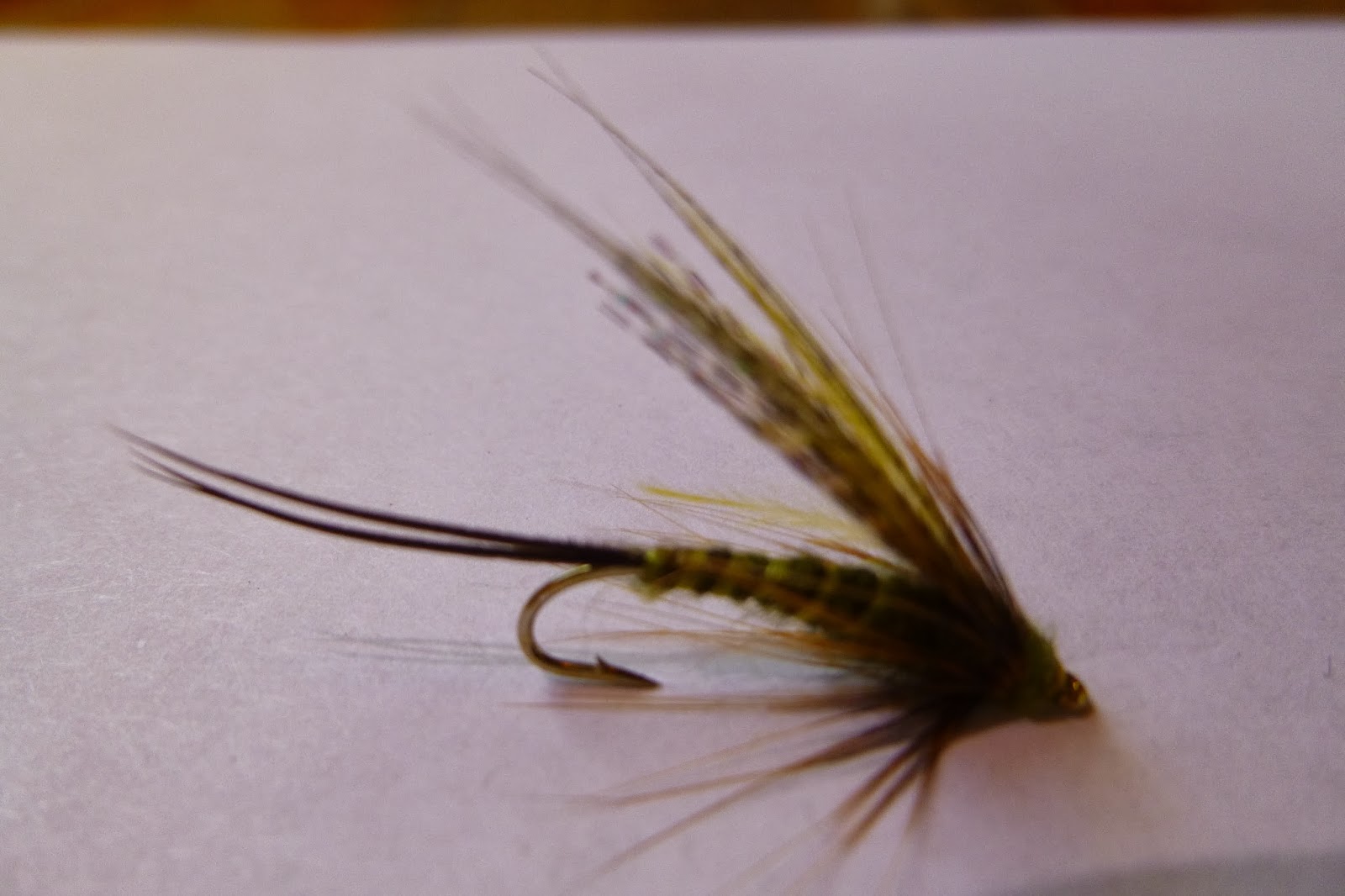
Sunset Baetis

Sunset Baetis tied by Steven Bird

I like this one for meeting red quills in low light conditions & June evenings, right up against dark when the bugs are thick & I want something that will stand out a bit from the crowd. Covers a variety of baetis & also western march brown. I fish it quartered, swung, dangled & lifted, downstream, but also fished upstream & dead-drifted, as the situation seems to call for.

Sunset Baetis

Hook: #12-#14 Daiichi 1150

Thread: Brown

Abdomen: Yellow floss overwound with copper tinsel – space winds so that the yellow shows as a rib – I spread a drop of Loon Hard Head on the body which serves to preserve the mylar tinsel & lend depth

Thorax: Dark peacock herl


Hackle: One turn of plover wing covert – & finish

Flyfish NE Washington with Steven Bird: http://ucflyfishing.blogspot.com

Tuesday, November 19, 2013

Larger Western Mayflies of Autumn

Lesser Green Drake tied by Steven Bird
Mahogany Dun tied by Steven Bird

      Wetfly takes on a couple of larger mayflies that are a significant autumn presence in the West: The lesser green drake (Drunella flavilinea); & the mahogany dun or blue quill (Paraleptophlebia bicornuta). Both of these mayflies occur over the spectrum of stream types; both are generally about the same size, #12-#14; & neither produces substantial hatches (that I’ve encountered), yet imitations of either are worthwhile, as they are in the mix, flavs into October, & mahogany duns into November or even later in southern ranges.

I think of the lesser green drake & mahogany dun as a ‘seasonal hatch’, their imitations worthwhile for ‘fishing the water’ throughout the season, in areas they are present. As nymphs, both of these species are crawlers; & both migrate to shallow water prior to final emergence. I think trout just as often see emerging, stillborn, or drowned spinner versions of  ‘flavs’ & mahogany duns, so, for that reason, I fish ‘winged’ patterns, which serve to cover those three modes: emerger/stillborn/spent adult. 
Profile of Lesser Green Drake Wing

Looking at the winged wetfly patterns here, & if you go back & look at Allen McGee’s mayfly patterns in the prior Journal entry, you'll notice that though the mayfly designs pictured are winged, they aren’t really “winged wetflies” in the traditional sense. The paired quill wings of ‘traditional’ designs are objectified & heavy, with little movement, tending toward somewhat less than diaphanous. The wings of mayflies, even drakes, are delicate, often transparent or semi-transparent so, to my mind, ‘less-is-more’ seems a good approach to simulating wings. Trout can see very well, & if they see too much, there is too much that can be seen as questionable & be rejected. But just a hint. An insinuation of a wing. Just a few fibers of light reflecting antron simulating a wing on a small fly, leaves little to dismiss as suspicious. The wings of mahogany duns remain colored through all stages, becoming semi-transparent toward the rear portions in the spinner stage. Both flavs & mahogany duns display & retain the most color &, in the case of flavs, veining, on the forward portions of the wings, & it is just the forward portion I'm attempting to simulate. 

Lesser Green Drake

Hook: #14 TMC 200R

Thread: Yellow

Tail: Black - three heavy feather fibers

Rib: Yellow latex 'floss' wound over the abdomen

Abdomen: Dark olive (BWO) Wapsi Superfine dubbed on yellow sewing thread – bodies on these are robust, build up with sewing thread

Thorax: Dark olive Wapsi Superfine

Wing: Stack: about a dozen natural mallard or gadwall flank fibers; a couple barbs of yellow marabou; 3 or 4 strands of olive or blue dun midge flash; top with a few fibers of olive-dyed mallard flank

Hackle: One turn of brown speckled game hen

Head: A turn of dark olive dubbing – & finish.


Mahogany Dun

Hook: #14 TMC 200R

Thread: Rusty brown

Tail: Ginger hackle fibers

Abdomen: Mahogany-brown goose biot

Thorax: March-brown Wapsi Superfine dubbing

Wing: Medium blue dun sections taken from a very soft secondary feather (I gather those dropped by molting gulls) – train opposing quarter inch sections straight out from the feather stem, fold together & cut from the stem for a matched pair

Hackle: One turn of ginger hen hackle – & finish.  


 Flyfish NE Washington with Steven Bird: http://ucflyfishing.blogspot.com


Sunday, November 10, 2013

Bird’s Riff On Carey Special

Bird's Carey tied by Steven Bird

     The old Carey Special is native to interior B.C. & stands as an indigenous pattern that has survived generations of popularity, while remaining mostly unknown beyond its native precincts.  And not unknown for lack of virtue as a getter, the pattern is a staple for lake fishing in my neck of the woods, but for the ambiguous nature of the fly itself, not being any one fly, but a pattern, a tying style, apparently too loosely defined to carry the name any great distance. You’ll find versions of it in fly boxes all over British Columbia, where it is extremely popular, & that popularity shading into Alberta, Washington, Idaho & Montana. Variants of the Carey are staples for lake fishing in Northeastern Washington & the dragonfly-rich lakes of the Okanagan region, both sides of the U.S./Canada border.   

The Carey Special was developed in the 1920’s by Colonel Tom Carey, a retired British soldier who, legend has it, came to the Okanagan wilderness of interior B.C. – Kamloops redband country – where he set up his tent at Arthur Lake, on a mission to develop the perfect trout fly. The perfect trout fly, the original version tied with a body of marmot fur & hackled with two to four cock ringneck pheasant rump feathers, was meant to simulate a dragonfly nymph. Carey called this version the Monkeyfaced Louise or The Dredge. As time passed more versions arose, with bodies of black bear or other fur dubbing, also deer hair, peacock herl, pheasant tail, colored yarns, fluorescent yarns, tinsel, chenille, all-black versions, steelhead versions – the pattern continually morphing, the only constant: the collar of pheasant rump hackle. The inspiration for the pheasant rump hackle may have come from an earlier B.C. pattern called the Pazooka (from local Indian slang, meaning ‘the medicine’). And I suspect the Carey design harkens back to the ancient designs of Britain.

There’s been many a battle won, I can personally attest, & regional popularity of the design does bear witness, yet, so far, Colonel Carey’s original mission remains unfinished, a victory never declared, the fly, never becoming one thing, only the ambiguous grail of a bright season at Arthur Lake. Yet the quest is not lost, as, somehow, the development of his design went fractal. So the nexus of Carey’s impossible mission has proven energetic if not attainable. Ah well. It’s the journey. It’s the journey. It’s the journey. The pattern continues to morph while still retaining its name – the name that Colonel Carey did not give it.

Everybody in the interior Pacific Northwest ties their own variant of the Carey Special. They are tied mostly tail-less, but also with a short, sparse tail of pheasant rump. And I’ve found that the Carey style does travel very well, a capable bait, particularly in still water & wherever fish are feeding on dragonfly or damselfly nymphs. A few of my favorite old-time Carey variants are tied with bodies of dark olive chenille; gold tinsel; peacock herl with a tail of golden pheasant tippet. The version featured here is my own take on it, trying to stay true to Colonel Carey’s original mission. This one fishes the local lakes, simulating dragon & damselfly nymphs, & also the big ‘traveling sedge’ habiting the lakes of my region.

Bird’s Carey

Hook: #4-#10 TMC 200R (Spending two or more years as nymphs, there are always the larger models available. I usually carry this in #6, & #10 to cover traveling sedge.)

Thread: Olive

Rib: Olive wire wound over the body – heavy, or medium for #6 & under

Body: Variegated brown wool yarn (mix of chestnut & darker brown)

Hackle: Cock ringneck pheasant rump feathers – take two of the soft, long barbed, church-window feathers from the base of the rump patch, one with brown tips & one with the greenish/bluish tips – one turn of each. Hackle should extend slightly beyond the hook bend. Work the hackle back & against the body with your fingers (or hold the fly under running water for a minute) – & finish.


     Flyfish NE Washington with Steven Bird: ucflyfishing.blogspot.com

Tuesday, November 5, 2013

Flyfishing & Writing ~ Scott Sadil


Evocative literature is a natural match for evocative fly patterns. Many of this journal's readers enjoy both, so I thought it might be a good idea to celebrate the first anniversary of SHJ with a nod toward some creative friends who produce both -- some of the folks Soft~Hackle Journal has been drawing inspiration from lately.

The first guy I tapped is Scott Sadil. Scott is a teacher, adventurer, wordsmith & soft-hackle brother who, it became apparent shortly into our initial conversation, harbors the observational skill of a heron. A skill we appreciate. The dude is a rare combination: a fine creative writer and a thoughtful fly designer & natural angler. Scott’s fly patterns hint at the intuitive/associative process we see embodied in the designs of those who spend a lot of time on the water pursuing the fishes & thinking about stuff, & his writing reflects that process at work.


I asked Scott for an excerpt salient to our game, and he gives us this from Fly Tales: Lessons in Fly Fishing Like the Real Guys

So much has been made of late for the efficacy of the wet fly swing by soft hackle aficianados like Sylvester Nemes and Dave Hughes that I’m surprised how infrequently I see other anglers employing this timeless and elegant technique.  This is, I confess, my favorite way to explore broken, seamy, or riffled water.  The mix of currents means your fly swims at different speeds, sometimes swinging, sometimes adrift on a slack line.  Practiced wet fly advocates fiddle with the angle of their casts, the timing of mends, the choice of dressing and hooks, all of which affect the depth and speed of the swing, the manner in which the fly is presented through the likeliest holding water. This is subtle to a point practically beyond words.  The wet fly swing invites the shrewd manipulations of rod, line, and fly that mark the presentationist’s game.  He feels his way through a run, recognizing through rod and line—and a kind of muscle memory—those unmistakable lies that can hold trout, a tactile familiarity that grows more pronounced each time a trout grabs the swinging fly.”  

Intrigued at the flies in the photos, I asked Scott about the pattern. 

Waking Muddlers tied by Scott Sadil


It is a true waking pattern, not meant to ride on or even in the surface membrane, but to ride or ‘bounce’ up against it from below. This, to my mind, is one of the often overlooked aspects of the soft-hackled fly: like so many things fish feed on, it rises to the underside of the surface membrane and gets trapped there by the strength of the surface tension. Fish, I believe, are much more willing to take things held below the membrane than they are to stick their noses into air, a move that essentially asks them to penetrate a new universe. The Waking Muddlers are sometimes grabbed without evidence of the fish eating, so subtle is the inhalation by the slowly risen fish. Just as often, of course, the take is visible, or, if the fly is inspected without a take, you will see evidence of the fish, which dials up angler attention in a way nothing else in steelheading can.”    ~Scott Sadil

More from Scott Sadil at his regular column in California Fly Fisher magazine, & here: http://scottsadil.com/titles.htm  


Thursday, October 31, 2013

The Pheasant Dace Streamer


     The simplest way to achieve articulation & movement in a fly is to construct it out of materials which possess those qualities (cute as those hinging shanks are). And still truly masterful is achieving beauty through functional simplicity that is easily duplicated.  
Pheasant Dace Streamer tied by Steven Bird

I can think of no material more useful to a fly tier than a complete cock ringneck pheasant cape. A pheasant cape will supply you with an assortment of soft feathers in an array of colorations from cream to black, & with some imitative combinations. The very soft, marabou-like ‘rump’ feathers found at the base of the tail are great for use as hackle collars, tailing, & also a lively topping or ‘wing’ for streamer flies – a ‘soft-wing’, if you will. I like these better than marabou for a lot of applications. The feather fibers have a little bit more spine than marabou & hold shape better. Pheasant rump feathers are available strung, in natural & dyed colors.

I intended the Pheasant Dace as a generic, all-purpose minnow pattern to simulate dace, chub, trout parr, sculpin, or most any baitfish found in trout waters, & I’ve found that it travels well.

Pheasant Dace

Hook: #8 up-eye steelhead style or streamer hook (the heavy wire steelhead style weights the fly & gets it deeper)

Thread: Olive

Tail: Golden pheasant crest feather – cupped side up -- same length as the body

Body: Silver tinsel (holographic tinsel might be a nice touch – red tinsel can be wound over the front quarter of the body to simulate gills – I apply a drop of Loon Hard Head & paint it over the tinsel with my needle)

Topping: Constructed similar to a flatwing, the pheasant feathers trained back & then tied in horizontal, cupped side down. Materials stacked thus: 1) pinch of white bucktail to form a base or ‘spine’ to support the wing, extending to about the tip of the tail; 2) a natural ‘cream’ pheasant rump feather; 3) two strands of olive flash to create a lateral line; 4) a natural dark pheasant rump feather

Throat: A small clump of yellow hackle fibers

Cheek: Jungle cock nails – & finish


Fish NE Washington with Steven Bird: http://ucflyfishing.blogspot.com              

Thursday, October 3, 2013

Miasmic October Caddis Pupa-Emerger

Miasmic October Caddis tied by Steven Bird


     It wouldn’t do to go into the Fall season without tying some October caddis pupa-emerger patterns. Writer-angler Gary LaFontaine considered this hatch one of the most important to those seeking big trout, & I agree with him on that one.

There are at least four subspecies of the giant Fall caddis (Dicosmoecus)  in the West; fairly similar in size & habit. Coloration varies somewhat, with abdomen coloration ranging from cream-yellow through shades of peach to deep pumpkin & rusty orange. In some watersheds nymphs exhibit an olive cast. Thorax areas of mature pupa I’ve sampled seem universally brownish with dark brown to black wing holsters. The wings of adults vary from spotted golden-tan to almost black. The one native to my homewater is pumpkin-orange, with black wings flecked with russet or gray, simulated very well with dark turkey tail. Mature pupae darken very quickly to the color of adults at the time of emergence. If you’ve not seen pupae at your target stream, but you’ve seen adults, then you have a good idea what color the pupae will be at maturity.

October caddis are case-builders, inhabiting all types of streams, slow to fast, more or less. We see them gathered along the edge of the stream in mid-summer, where they attach to stones or debris, seal off the case & pupate for about two months. At maturity, pupae chew through the door & crawl toward shore or swim to the surface to complete emergence. These are wide-spread, adaptable, tough insects. I am not an entomologist (I am a bait man), my observations are parking lot anecdotal & based on my own experiences astream, nonetheless, there by fortune, I’ve encountered & fished over October caddis from So. Cali to B.C. on a spectrum of water, observing at least a couple of emergence strategies (which I suspect have something to do with water speed & stream geology) including: crawling from the water onto streamside rocks & vegetation, & also emerging from shallow water, & possibly emerging from deeper water as well. I’ve seen the big sedges pop from runs that I know to be eight feet deep, but it is possible they drifted from shallower areas while undergoing final emergence. I’ve found evidence suggesting that some pupae emerge while clinging to the bottom, as they would on streamside rocks, & ascend to the surface very quickly as adults. And that seems to more closely jibe with the crawling onto dry land to emerge strategy. They don’t let a little water get in the way when it’s time to fly. The wings are strongly constructed & possess a waxy, water-repellent  coating which may aid in buoying them to the surface. 

October caddis emerge from late August through November, with peak season September & October, & I have seen them emerge from coastal streams through the winter months. With the rare exception, we seldom encounter big hatches of these. October caddis are what I call a ‘seasonal hatch’. They are a presence & available through their emergence period & trout are used to finding them in the drift. Trout eat all stages of OC, though, in my own experience, the adult pupa, the most vulnerable stage, is the most worthwhile to imitate, with the adult (dry) a middling second, though big fun when fish are in the mood, & I always give them a try.


Miasmic October Caddis Pupa

Hook: #8-#10 (I like TMC 200R or an up-eye steelhead/salmon hook 

Thread: Black

Rib: Copper wire wound over the abdomen

Abdomen: Pumpkin-orange antron/rabbit blend cut with a pinch of Wapsi sulfur yellow (has a chartreuse-y olive cast) superfine dubbing, applied to a dubbing loop of yellow poly/cotton sewing thread 

Thorax: puff taken from the base of a dyed-brown mallard flank feather arranged around the hook shank as a collar – should extend to about the middle of the abdomen – you can pinch away any excess – I use orange puff on coastal versions meant for steelhead & sea-run cutthroat

Hackle: Brown church window cock ringneck pheasant body feather

Head: Dyed-brown hare’s mask with guard hairs twisted on the tying thread

I weight mine with copper or lead wire under the thorax area. For a quicker build-up (& saves tying thread), I begin the fly with the yellow sewing thread used for the dubbing loop, tying in the copper wire for the rib, shaping the body & forming the loop before tying in the black thread at the hook eye.    

   
 Flyfish NE Washington with Steven Bird: http://ucflyfishing.blogspot.com/ 

Sunday, September 22, 2013

Soft-Hackle Yellowjacket – Sympathy for the Devil


     Late summer & fall, the terrestrial patterns come more into play. It’s grasshopper season, up until the first frost knocks them out of commission. And where grasshoppers are scarce, ants & beetles fill the bill for many of us – & that while the most ubiquitous insect of the season orbits our sweaty heads or fishy hands menacingly, or perhaps, landing on our exposed calf to incise a V-shaped chunk of meat & delivering a painful sting on top of the wound when swatted.

     I suspect it might be the devilish nature of yellowjackets, & our stand-offish attitudes toward them, responsible for the wasp’s lack of consideration as good bait. We don’t like to think about them. Most of us see no poetry of grace embodied in a fat insect sporting electric prison stripes, an aggressive attitude, working mouth parts & a stinger. That’s not to say we ignore the yellowjacket entirely, we don’t. The McGinty, a cute rendition in most of its incarnations, is still fairly well-known, though I doubt it gets nearly the play it got in the last century. In their writings, Ray Bergman & Roderick Haig Brown noted the importance of yellowjackets as trout food, & offer imitations, as have other observant writer-anglers  – yet the yellowjacket still remains largely unconsidered & absent from fly boxes, & that may be due to those nasty habits I mentioned, I don't know. I want to say I think them the most reliable trout stream terrestrial to imitate, while I (regularly) struggle to avoid those kind of empirical remarks reflecting no other but my own experience.    

     (The largest trout I ever caught on a dryfly was on a floating yellowjacket imitation.)

     Yellowjackets are common around water, particularly in late-summer through autumn, pretty much everywhere trout are found. They hunt other insects over the water & the wind knocks a lot of them down while they struggle to fly holding their prey. Periodic checks of stomach contents show evidence that trout like to eat yellowjackets & do so whenever the opportunity shows itself. I’ve often found multiples, indicating the wasps are fairly available in the water at times, particularly when it’s breezy. And yellowjackets have a long season, so no doubt trout are used to seeing them.

     Being heavy, wasps don’t float well, usually breaking the surface tension while struggling on the water, & drowning, making them available to trout throughout the water column. I suspect trout eat more drowned yellowjackets than they do live ones. Though I fish both wet & dry versions, the wet version presented here gets the nod as a staple pattern for fishing the water in fall, East or West, September into October. I tie these unweighted & fish them with a floating line, most often cast upstream & drifted, high-stick style, but also quartered & swung.

Yellowjacket

Hook: #8-#10 I prefer a #8 caddis style, which imparts the characteristic bend of a disabled wasp

Thread: yellow

Ribbing: black 3/0 uni-thread

Abdomen: I build a tapered ‘dumbell’ shape with yellow sewing thread, then tie in with yellow tying thread & wind to the tip of the abdomen well down the hook bend, form a little stinger, then tie in the rib & yellow floss, finish shaping the abdomen with the floss, then wrap the rib forward, seven turns, over the abdomen – once the rib is formed, I continue, solid through the girdle area & onto the thorax hump with the black thread. Coat the abdomen with two or three coats of Loon Hard Head for a durable, realistic abdomen.

Thorax: black rabbit dubbing

Wing: a tiny clump of puff taken from the base of a dyed-brown mallard flank feather, CDC or marabou – when wet, this reduces to just a hint of color, simulating the brownish coloration we see at the base of yellowjacket wings – the glassy puffs found at the base of mallard flank feathers are my favorite material for imparting the hint of wings or creating miasma – bags of dyed mallard flank are available at low cost & have a lot of uses

Hackle: soft grizzly, dyed yellow

Head: black dubbing in front of the hackle – & finish