Monday, February 1, 2016

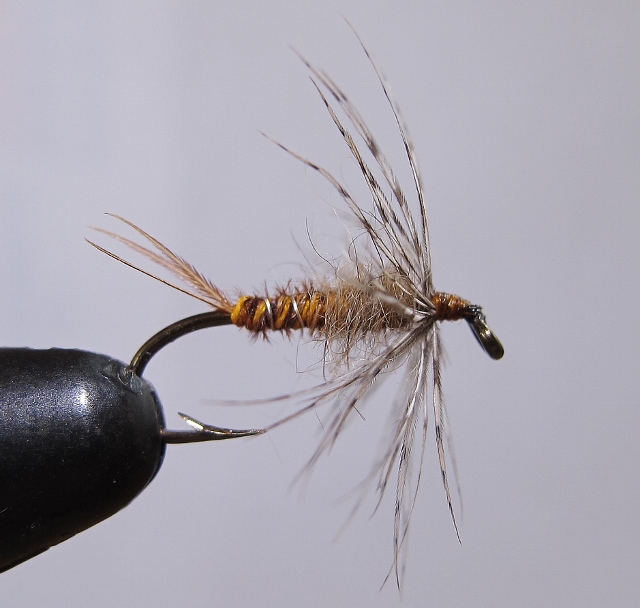
Grannom Sedge Emerger

     Time passing swiftly, I’m getting to work on refreshing my supply of spring & summer trout flies. Looking through the boxes it occurred to me that: even though I tie & carry a considerable assortment, only about a half dozen patterns account for most of the trout I caught last season. And one pattern in particular stands out, my log indicates, a simple olive sedge emerger, this one pattern accounting for about a third of the trout I catch in a season.

That says something about the importance of caddis as trout bait. And particularly the emerging pupa phase.

Admittedly, my home water is a caddis river, its mayfly hatches sporadic & mostly unpredictable. But isn’t that the case in a lot of places? And no matter, as, spring & summer, the sedges produce daily hatches serving to get trout up & going. Mayflies are the occasional steak dinner, while sedges are the daily ration.

On a lot of streams, East & West, grannom is the first reliable hatch of spring. Following grannom, in the West, are the more prolific spotted sedge, so similar they are often mistaken for grannom. The pattern featured here covers both of these species, & tied in sizes #10-#18, will cover many others one might encounter anywhere.

The version featured is tied on a Mustad 3366-BR, a hook I like a lot. This straight-eye sproat design is popular for tying North Country wetflies, traditionalists claiming it tracks & hovers like the eyeless hooks of old, the performance preferable to modern down-eye designs. The Mustad 3366-BR is very inexpensive, about five bucks for a 100 pack, & I don’t know why, but that is good. These are sized smaller than standard wetfly, a #10 equal to a #12 standard wetfly. I tie standard #12’s & #14’s on a #10, & #14’s & #16’s on a #12 3366-BR. These aren’t heat treated as brittle-hard as English hooks, so the barb can be pinched down without fracturing the hook point – & the ample barb leaves a generous fish-holding hump when pinched.

Grannom Sedge Emerger

Hook: #10-#18 (natural grannom is about #12 – nymphs are a size larger than adults)

Thread: camel UNI 8/0

Rib: olive-pearl krystal-flash, 2 strands, twisted, & wound over the abdomen as a rib – then wind solid through the thorax area, providing a ‘light’ base that will show under the thorax dubbing

Abdomen: light olive rabbit, touch-dubbed on a strand of light olive Pearsall’s silk, or light olive tying thread

Thorax: brown-dyed hares mask, short, loosely dubbed


Hackle: brown partridge, grouse or brahma hen ~ & finish.

Thursday, January 7, 2016

Hair & Hen Muddler

 
Natural Sculpin Muddler
          The importance of freshwater sculpin as trout food has become fully realized in our time, & that realization spawning the vast array of fly patterns meant to simulate them. Some of these are incredibly realistic, like dolls, some with doll eyes, the eyeballs rattling around in little plastic domes (even though the eyes of the naturals are generally mottled camouflage like the rest of the body & barely discernable). Many are bulky, ranging from awkward to dangerous when cast. (No problem, you stick a pin in the doll & fish simply float up!) 
Purple Muddler

Still, it’s hard to beat the original Muddler Minnow, tied by Don Gapen, & I’d place Jack Gartside’s Sparrow right up there beside it as a sculpin imitation. Considering that most species of freshwater sculpin are two inches long or less at maturity, Gartside’s Sparrow, generally fished in smaller sizes than the Muddler, makes perfect sense. Both of these killing patterns have two things in common: both offer the classic, big-headed, sculpin profile, & both are constructed of natural materials that blend together when wet, mimicking the blotchy coloration & texture of the naturals.
Chartreuse Muddler

If you’ve caught a natural & looked at it in hand, or if you’ve seen pictures, you might have noticed that the critter looks like primordial brown/olive camo ooze fashioned to an elongated teardrop shape, & other than the profile, the most outstanding characteristic, the dark barring on the body, usually three or four dark patches (& yes there are the large pectoral fins, but these are held close to the body when the sculpin is in motion). In designing the Hair & Hen Muddler I was looking for a version of about two & a half inches in length that, when wet, would closely imitate a natural in shape, movement & coloration. This one comes alive when wet, & worked very good for us this past season. I tie these in purple & chartreuse as well, & there are a lot of possibilities with dyed squirrel & kip tails. Works as a craw for smallmouth bass as well. 

Hair & Hen Muddler

Hook: #2-#4 Mustad 3366-BR

Thread: black, brown, tan or olive UNI 6/0

Tailing: squirrel tail

Gills: red tinsel wound on the hook shank

Body: in order tied in, on top of the shank: olive calf tail; squirrel tail; olive calf tail; squirrel tail; olive calf tail; squirrel tail; olive calf tail, on this last one, a pinch on top & a pinch on both sides of the hook shank (this will support a flared head shape once the hackle is wound in – each hair clump is placed a bit forward (shorter) than the one preceding it, I use the color bars on the hair as a guide, stepping the hair clumps forward a bar at each step 

Lateral Line: copper mylar flash, one strand, both sides

Head (Hackle): in order tied in: bronze mallard, gadwall flank or brahma hen, Coc de Leon is perfect if you have it; then work toward the eye with dyed olive grizzly hen (3 to 4 hackles) diminishing the size of the hackle slightly as you go forward ~ & finish    


Monday, January 4, 2016

Jim Leisenring’s March Brown

     Meant to simulate a number of Rithrogena (clinger) mayfly species emerging to speckled winged adults, ‘March Brown’ is a tag applied to nearly as many versions of the fly as there are fly tyers &, in some form, has been described since the earliest English literature.   

Rithrogena prefer streams with good flow, & larger freestones may produce great hatches. Those species we refer to as March brown begin emerging before spring run-off, as early as February in southern & coastal regions, later at higher elevations & northern regions. Generally, these appear around late April in NE Washington, & I see them on into June some years. Though they don’t produce great hatches on my home water as they do in many places, they are enough of a presence through their hatch season that the imitation fishes well through the period.   

Looking at naturals found at various locations, one isn’t surprised at the great variety of patterns meant to cover March brown. Adults may be #12-#16 (nymphs, a size larger). The color of mature nymphs may range from tan through all shades of brown, olive/brown, & olive, depending on location. Each stream holds its own color variant. (An aquarium net might satisfy the curious.) Considering the variety of colors & materials meant to simulate these, I am drawn, once again, to the notion that: presentation, size, silhouette, are primary factors, over color. And in this case silhouette is indeed important, by my own thinking, as the broad-thoraxed, teardrop shape of the naturals is a keying visual characteristic.

One of James Leisenring’s salient contributions to the soft-hackle style was his refinement of silhouette, which he considered important to the fly’s effectiveness, & for that reason many of his patterns call for a thorax, & though not his own invention, it is a fair departure from most of the older soft-hackle designs. Jim Leisenring’s well-thought version still stands as a killing pattern for covering March browns.

Neil Norman, author of Soft Hackles, Tight Lines, an Online Soft-Hackle Pattern Book, lays out an excellent historic profile of March brown, describing several notable dressings. For any interested in the history of our flies, Neil’s journal is an invaluable archive.                

Jim Leisenring's March Brown

Hook: #10-#14 (Mine is tied on a #12 Mustad 3906B)

Thread: orange silk (orange or rusty-brown UNI 8/0 substitutes)

Hackle: brown partridge

Tail: 3 cock pheasant tail swords

Rib: gold or silver wire wound over the abdomen

Abdomen: 3 or 4 cock pheasant tail swords twisted with a tag of the thread

Thorax: hare’s mask, dubbed fairly heavy


Thursday, December 10, 2015

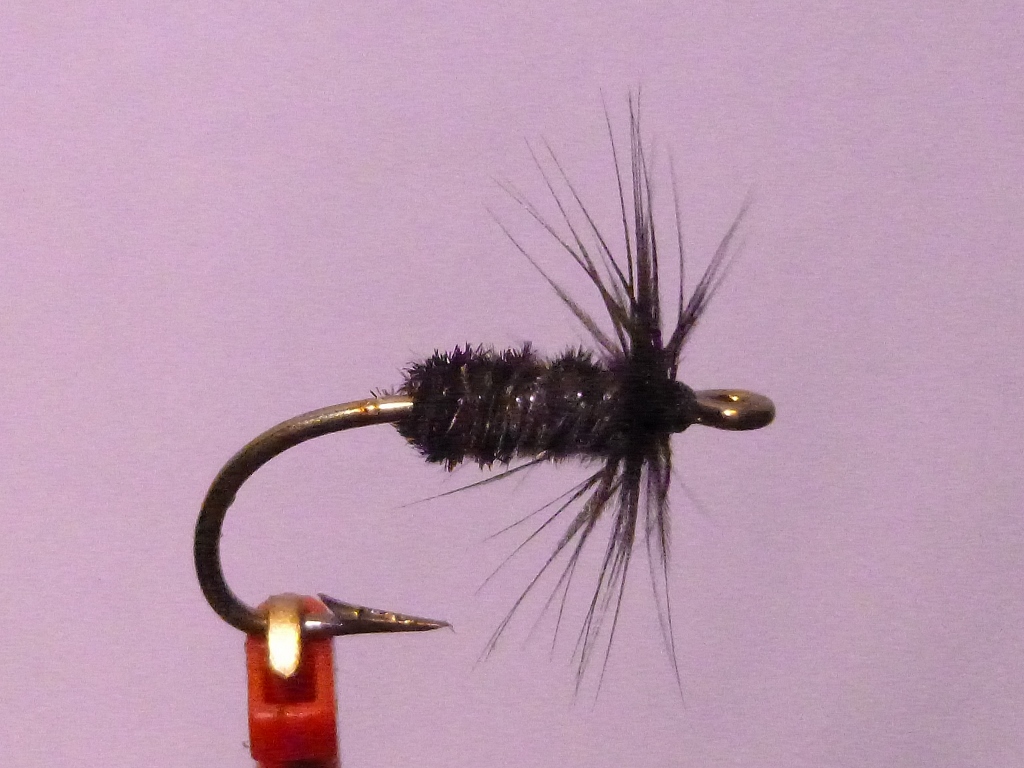
Twist Beetle

    Been on a twisted body kick lately & playing with them a lot. Don’t worry. The fly kind. I get excited about something & I go on a roll.   

I love the striking effects created twisting varying materials – tail & wing swords, herl, threads, tinsels, floss – together into a rope & then winding it as the fly body. The wee beetle presented here represents the austere side of the spectrum of possibilities, using a single material, made from twisted swords taken from a bronze/black turkey body feather.

There’s nothing new about the idea of making a simple beetle pattern from twisted herl. My beetle was inspired by the Bracken Clock, a North Country beetle pattern made from peacock herl twisted with red silk. The Bracken Clock was described by William Brumfitt in an 1875 text, so has surely been around longer than that. Unlike the Americans who are always looking for something new, The Brits refine a fly pattern to ultimate usefulness, then they all tie it precisely that way, fish it for 300 years, & do fine.

Wanting to make a smaller beetle than peacock herl allows, I chose a bronze/black body feather taken from a Merriam turkey, twisting the feather barbs, or ‘swords’, with the tying thread to form a rope of herl for the body. The dark, iridescent, turkey body feather reflects green & copper highlights, & these subtly hinted in the twisted fly body.

The pattern makes a fine tiny beetle &, turns out, serves well to cover wee freshwater snails as well. Some places, it might even be more useful as a snail pattern most of the time.

Twist Beetle

Hook: #12-#18 (photo fly is tied on a Mustad 3366)

Thread: black UNI 8/0

Body: bronze/black turkey body feather barbs or ‘swords’ (about 8 for a #14) twisted with a tag of the tying thread – use more swords or build up an underbody with thread for a rounder body

Hackle: black hen or starling ~ & finish.          


Saturday, November 21, 2015

Twisted Logic ~ Lemon Twist Spider


     Most have heard, or surmised, that the color of The Universe is brown. We see the prevalence of brown in nature. I see it in my flybox, rows & rows of drab variations of brown. We see it reflected in the colorations of stream nymphs: brown, tan, olive, yellow. (Black is not a color.) Mix them all together & you have brown. 

Combine all the people of the world into one person & you will have one, large, brown person. (How do we treat others? There are no others.)

Of course, regarding simulation, we prefer to cover the spectrum. Sometimes starkly obvious variety is what we need to turn the trick.

Aside from being a good attractor in general, his one will cover a lot of specific insects – Yellow Sally & Pale Evening Dun come immediately to mind. Good to have something all-yellow in the box.

Lemon Twist

Hook: #12-#16 (foto is #12 Mustad 3366-BR)

Thread: yellow UNI 8/0

Body: yellow goose primary swords twisted with the tying thread (3 for a #12), & a short thorax of pale yellow yarn, loosely dubbed

Hackle: yellow grosbeak body feather (flew against the window with bittersweet result)(yellow hen will substitute) ~ & finish.


Wednesday, November 18, 2015

An Old Thorobred

     Cruising by a yard sale I notice what looks like flyrods poking up above the assemblage of stuff. Curious, I pull over.

The rods are a Wright & McGill bamboo, & a glass Heddon Thorobred, bunched with a set of rusty golf clubs.

I look the rods over.

The guides & guidewraps are degraded & missing on both. The bamboo would need a lot of work… but do-able.

Other than needing a guide set, the Heddon blank is pristine & straight; the grip & reelseat in good shape. A two-piece, 8’, D-HDH. Considered an all-around trout rod in it’s time. It would throw 5wt or 6wt lines. I like its tobacco color – the color of old mojo.

The ferrules are good. I put it together & wave it, shaking a parabola into the air. It feels good. A lot like bamboo. At the time of its making, probably around 1952, parabolic split-cane actions were the model for Heddon’s newly introduced line of glass rods. It is surprisingly light. I picture it restored & doing business again, trying to imagine a suitable color change for the guidewraps.

 Among the items on display atop a retired coffee table are two Ocean City Wanita flyreels, the same vintage as the rods. The smaller of the reels features a mummified silk line & I presume it is mated to the old bamboo Wright & McGill. I pick up the larger reel & wind on it & it works fine. A perfect match for the Heddon glass.

A guy comes out of the garage. I try to act uninterested. The rods were his dad’s, he says. He doesn’t fly fish & he needs to make room in the garage for his monster truck.

I probably could get it for less, but my mouth jumps ahead of my brain & I hear myself offer 100 bucks for the two rods & reels.

Done deal.

Though an earlier issue, the Heddon Thorobred is very similar to the 8’, 6wt Heddon Pal my grandfather gave me in 1960. That one lived up to its name, truly a pal, until meeting its demise in the early ‘70’s when it bounced out of the bed of a friend’s pickup strapped to my backpack frame, shattering on the road. It still haunts me.

Anxiously awaiting the new guide set & some A thread for the Heddon. I’d like to fish it before the end of the year, new again. To be continued.   

Sunday, October 4, 2015

Love Pink


     There are some every year in fall. Yet it is every other year, during odd-numbered years, pink salmon, or ‘humpies’, ascend the river systems of northwestern Washington in numbers great enough to humble even the thickest among us, crowding portions of the rivers, delighting snaggers & vexing fly casters challenged to make them bite.


     The humpbacked bucks run about 3 to 6 pounds, & the autumn colored hens about 2 to 4 pounds. The hens, to my eye, are among the most beautiful of salmonids. With broad, powerful tails, humpies are strong, active fighters. Pound for pound, I’d give them the nod over chinook.

    And humpies will bite. They aren’t eating, but they are a primitive, automatic kind of fish, & they will bite the fly if the angler can figure out where their trigger button is that day. Oh, it is true that on some days, lucky days, & for mysterious reasons, humpies will go on the bite – & bite anything. But, everybody knows, that is usually not the case. Most of the time you’re left to cipher exactly how they want the fly presented.


     Fortunately, fly color is no great decision, as the humpy’s penchant for prawn colors -- combinations of red, orange, pink & white -- is a fair constant, though they do seem to appreciate a nicely detailed pattern.


   Presentation is what they’re really picky about. Common knowledge has it that humpies like the fly jigging (Clouser-style patterns are popular), & that’s true, though not always the case – & wasn’t the case on a recent trip to the Skykomish, where, I eventually found out, they wanted the fly swinging, dead-drift, tickling the bottom. Swinging. Not jigging. That made me happy.