Monday, March 7, 2016

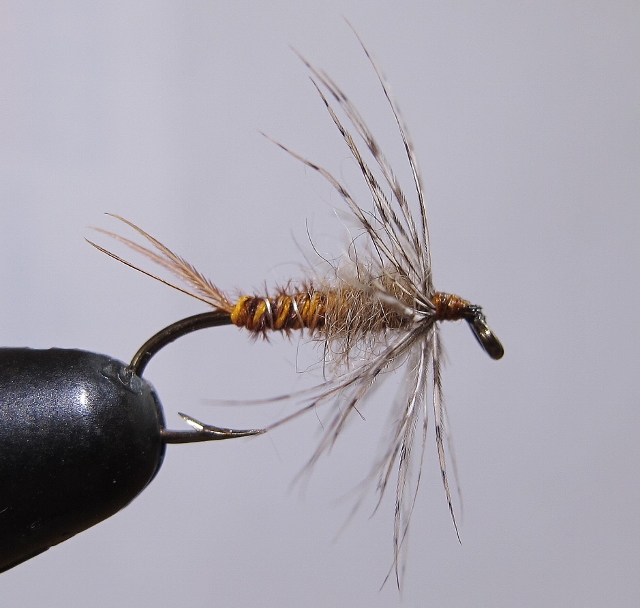
Wine Merchant

Wine Merchant ~ Steven Bird 
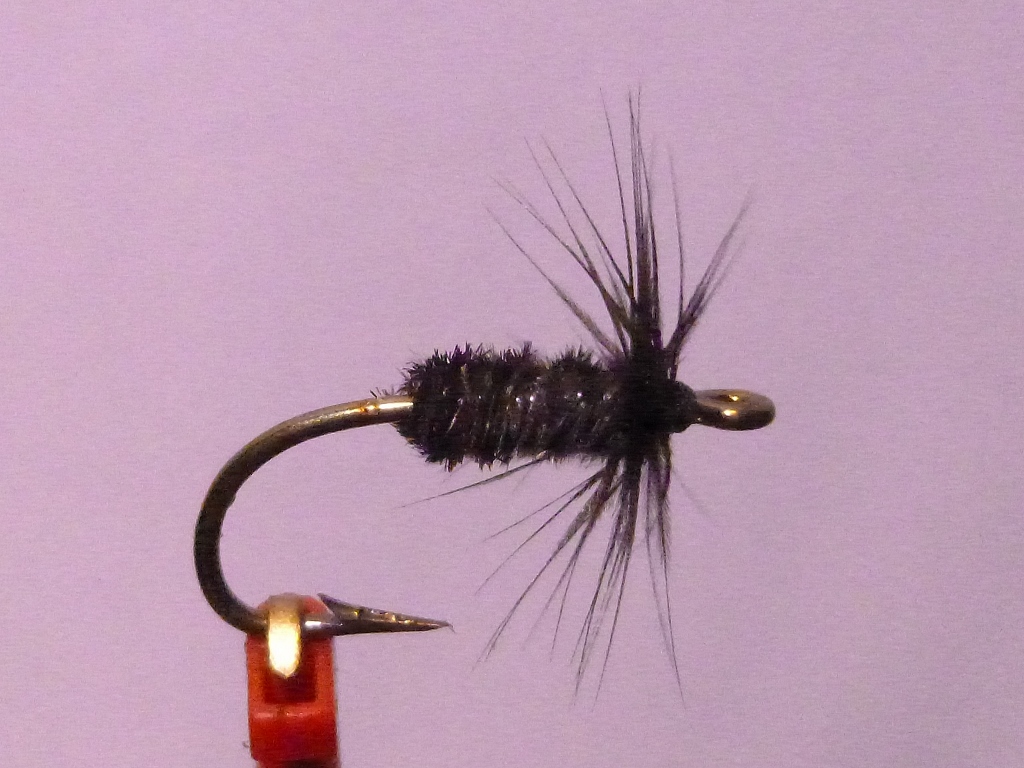
    Leisenring’s Black Gnat is a killing fly, long one of my favorites. Never being able to leave well-enough alone, I’m always tinkering with the sexy mingling of black & claret that, I think, makes the LBG so effective. This version sprouted some distance from the parent tree, took up trade & changed its name.

For fun.


Wine Merchant

Hook: #12 Mustad 94840

Thread: wine UNI 8/0

Hackle: natural black/bronze hen


Body: claret yarn, single strand, touched with black rabbit & twisted 

Wednesday, March 2, 2016

Walleye on the Fly

        Canadian & American surveys of the upper Columbia, above Lake Roosevelt, indicate that up to 70% of the native fish species spawned within the system are eaten by walleye before reaching maturity. Short of pulling down the dams & allowing the river to flush, there is no plan other than suppression for reducing their numbers. Biologists think if the 70% depredation rate can be decreased by about 7%, native trout may remain sustainable. Toward that goal, Washington & Oregon have suspended catch limits on walleye, as well as other introduced, non-native species – channel catfish, bass, & northern pike.   

Always has to be some dufus who wants those fish like he caught back home in Alabama or Wisconsin. Walleye were illegally bucketed into the upper Columbia in the 1950’s, & from there have fenestrated downstream to inhabit the entire river. Below Chief Joseph Dam, where there are still salmon, walleye munch salmon smolts.

It’s not a good situation.

Walleye are good, filleted & fried, but they are not good fighters. A big one is good for a short, bulldogging fight, but that’s it.

In fall, during the October caddis hatch, walleye move onto those areas which traditionally concentrate trout, to feed on the big fall caddis. For a few evenings in September walleye were thick on one of my favorite trouting locations, & quick to take the swung October caddis imitation – so I did what anybody would do.

Skillet biology.

Filleting those sacks of walleye was a task nearing commercial proportions, but was worth it. Invitations were sent out, beer was brought in. The friends from up & down the river had a great time at the fish fry.

(Some of us had too good a time.)

And in the end, everybody agreed that skillet biology was a pretty good way to counter the harmful affects of bucket biology.

We do our best.       


Monday, February 22, 2016

A Close Look At Freshwater Scuds

Brian Briscoe photo
   Upper Columbia flyfisher & photographer, Brian Briscoe, has embarked on the ambitious project of photo recording the various menu items found in the upper Columbia mainstem & drainage. Brian kindly shares his amazing work with SHJ. The scuds were collected from a B.C. lake & exhibited at the annual West Kootenay Fly Fishing Club Symposium last year. There is a lot to be learned from studying these photos. As scuds are important trout forage in most lakes & slow waters, Brian’s observations on shrimp form & behavior shed light on effective imitation.

Brian Briscoe photo
The shrimp in the photos are mature, at about ¾ inch in length. A size that seems to surprise Eastern anglers, though I’ve found ¾ inch models in the Washington lakes I fish, as well. As it is with aquatic insects, we see that colorations vary within a population, shades of olive, & many exhibiting an attractive flare of bright orange or pink at the tip.


Brian Briscoe photo
Brian makes a truly salient point regarding tying imitations of these, pointing out the fact that scuds straighten their bodies when in motion. They swim very rapidly in bursts, the body held straight. Only when not in motion do they assume the characteristic ‘C’ shape we see so often in popular imitations. These swimming scuds might be well-simulated tied on a long-shanked, drop-bend hook like the TMC 200R, the profile, to my eye, a near perfect match.
Brian Briscoe photo

Scuds are bottom dwellers, so imitations are best fished deep. I can see that the ‘C’ shaped profile might do well dead-drifted beneath a bobber, but if the imitation is to be delivered via a sinking line & dredged near the bottom, stripped, one might be better served with an imitation tied on a ‘conventional’ hook design affording a straight profile. To my own eye, a Carey Special design, stripped, might be a closer match than a ‘C’ shape scud design for simulating the swimming shrimp in the photo at the left.

Brian Briscoe photo
In improving one’s game, there is no substitute for observations garnered from time on the water, surely. Thankfully, & fortunately for fly tiers, those like Brian, whose curiosity leads them to record what is in the water, offer fly tiers a unique, valuable window, through the frozen image. Well done, Brian. Much thanks for sharing your work with us.

More on scuds in this excellent article by Phil Rowley: http://www.flycraftangling.com/index.asp?p=123  


Brian Briscoe photo
 
Brian Briscoe photo
 
Brian Briscoe photo

Monday, February 1, 2016

Grannom Sedge Emerger

     Time passing swiftly, I’m getting to work on refreshing my supply of spring & summer trout flies. Looking through the boxes it occurred to me that: even though I tie & carry a considerable assortment, only about a half dozen patterns account for most of the trout I caught last season. And one pattern in particular stands out, my log indicates, a simple olive sedge emerger, this one pattern accounting for about a third of the trout I catch in a season.

That says something about the importance of caddis as trout bait. And particularly the emerging pupa phase.

Admittedly, my home water is a caddis river, its mayfly hatches sporadic & mostly unpredictable. But isn’t that the case in a lot of places? And no matter, as, spring & summer, the sedges produce daily hatches serving to get trout up & going. Mayflies are the occasional steak dinner, while sedges are the daily ration.

On a lot of streams, East & West, grannom is the first reliable hatch of spring. Following grannom, in the West, are the more prolific spotted sedge, so similar they are often mistaken for grannom. The pattern featured here covers both of these species, & tied in sizes #10-#18, will cover many others one might encounter anywhere.

The version featured is tied on a Mustad 3366-BR, a hook I like a lot. This straight-eye sproat design is popular for tying North Country wetflies, traditionalists claiming it tracks & hovers like the eyeless hooks of old, the performance preferable to modern down-eye designs. The Mustad 3366-BR is very inexpensive, about five bucks for a 100 pack, & I don’t know why, but that is good. These are sized smaller than standard wetfly, a #10 equal to a #12 standard wetfly. I tie standard #12’s & #14’s on a #10, & #14’s & #16’s on a #12 3366-BR. These aren’t heat treated as brittle-hard as English hooks, so the barb can be pinched down without fracturing the hook point – & the ample barb leaves a generous fish-holding hump when pinched.

Grannom Sedge Emerger

Hook: #10-#18 (natural grannom is about #12 – nymphs are a size larger than adults)

Thread: camel UNI 8/0

Rib: olive-pearl krystal-flash, 2 strands, twisted, & wound over the abdomen as a rib – then wind solid through the thorax area, providing a ‘light’ base that will show under the thorax dubbing

Abdomen: light olive rabbit, touch-dubbed on a strand of light olive Pearsall’s silk, or light olive tying thread

Thorax: brown-dyed hares mask, short, loosely dubbed


Hackle: brown partridge, grouse or brahma hen ~ & finish.

Thursday, January 7, 2016

Hair & Hen Muddler

 
Natural Sculpin Muddler
          The importance of freshwater sculpin as trout food has become fully realized in our time, & that realization spawning the vast array of fly patterns meant to simulate them. Some of these are incredibly realistic, like dolls, some with doll eyes, the eyeballs rattling around in little plastic domes (even though the eyes of the naturals are generally mottled camouflage like the rest of the body & barely discernable). Many are bulky, ranging from awkward to dangerous when cast. (No problem, you stick a pin in the doll & fish simply float up!) 
Purple Muddler

Still, it’s hard to beat the original Muddler Minnow, tied by Don Gapen, & I’d place Jack Gartside’s Sparrow right up there beside it as a sculpin imitation. Considering that most species of freshwater sculpin are two inches long or less at maturity, Gartside’s Sparrow, generally fished in smaller sizes than the Muddler, makes perfect sense. Both of these killing patterns have two things in common: both offer the classic, big-headed, sculpin profile, & both are constructed of natural materials that blend together when wet, mimicking the blotchy coloration & texture of the naturals.
Chartreuse Muddler

If you’ve caught a natural & looked at it in hand, or if you’ve seen pictures, you might have noticed that the critter looks like primordial brown/olive camo ooze fashioned to an elongated teardrop shape, & other than the profile, the most outstanding characteristic, the dark barring on the body, usually three or four dark patches (& yes there are the large pectoral fins, but these are held close to the body when the sculpin is in motion). In designing the Hair & Hen Muddler I was looking for a version of about two & a half inches in length that, when wet, would closely imitate a natural in shape, movement & coloration. This one comes alive when wet, & worked very good for us this past season. I tie these in purple & chartreuse as well, & there are a lot of possibilities with dyed squirrel & kip tails. Works as a craw for smallmouth bass as well. 

Hair & Hen Muddler

Hook: #2-#4 Mustad 3366-BR

Thread: black, brown, tan or olive UNI 6/0

Tailing: squirrel tail

Gills: red tinsel wound on the hook shank

Body: in order tied in, on top of the shank: olive calf tail; squirrel tail; olive calf tail; squirrel tail; olive calf tail; squirrel tail; olive calf tail, on this last one, a pinch on top & a pinch on both sides of the hook shank (this will support a flared head shape once the hackle is wound in – each hair clump is placed a bit forward (shorter) than the one preceding it, I use the color bars on the hair as a guide, stepping the hair clumps forward a bar at each step 

Lateral Line: copper mylar flash, one strand, both sides

Head (Hackle): in order tied in: bronze mallard, gadwall flank or brahma hen, Coc de Leon is perfect if you have it; then work toward the eye with dyed olive grizzly hen (3 to 4 hackles) diminishing the size of the hackle slightly as you go forward ~ & finish    


Monday, January 4, 2016

Jim Leisenring’s March Brown

     Meant to simulate a number of Rithrogena (clinger) mayfly species emerging to speckled winged adults, ‘March Brown’ is a tag applied to nearly as many versions of the fly as there are fly tyers &, in some form, has been described since the earliest English literature.   

Rithrogena prefer streams with good flow, & larger freestones may produce great hatches. Those species we refer to as March brown begin emerging before spring run-off, as early as February in southern & coastal regions, later at higher elevations & northern regions. Generally, these appear around late April in NE Washington, & I see them on into June some years. Though they don’t produce great hatches on my home water as they do in many places, they are enough of a presence through their hatch season that the imitation fishes well through the period.   

Looking at naturals found at various locations, one isn’t surprised at the great variety of patterns meant to cover March brown. Adults may be #12-#16 (nymphs, a size larger). The color of mature nymphs may range from tan through all shades of brown, olive/brown, & olive, depending on location. Each stream holds its own color variant. (An aquarium net might satisfy the curious.) Considering the variety of colors & materials meant to simulate these, I am drawn, once again, to the notion that: presentation, size, silhouette, are primary factors, over color. And in this case silhouette is indeed important, by my own thinking, as the broad-thoraxed, teardrop shape of the naturals is a keying visual characteristic.

One of James Leisenring’s salient contributions to the soft-hackle style was his refinement of silhouette, which he considered important to the fly’s effectiveness, & for that reason many of his patterns call for a thorax, & though not his own invention, it is a fair departure from most of the older soft-hackle designs. Jim Leisenring’s well-thought version still stands as a killing pattern for covering March browns.

Neil Norman, author of Soft Hackles, Tight Lines, an Online Soft-Hackle Pattern Book, lays out an excellent historic profile of March brown, describing several notable dressings. For any interested in the history of our flies, Neil’s journal is an invaluable archive.                

Jim Leisenring's March Brown

Hook: #10-#14 (Mine is tied on a #12 Mustad 3906B)

Thread: orange silk (orange or rusty-brown UNI 8/0 substitutes)

Hackle: brown partridge

Tail: 3 cock pheasant tail swords

Rib: gold or silver wire wound over the abdomen

Abdomen: 3 or 4 cock pheasant tail swords twisted with a tag of the thread

Thorax: hare’s mask, dubbed fairly heavy


Thursday, December 10, 2015

Twist Beetle

    Been on a twisted body kick lately & playing with them a lot. Don’t worry. The fly kind. I get excited about something & I go on a roll.   

I love the striking effects created twisting varying materials – tail & wing swords, herl, threads, tinsels, floss – together into a rope & then winding it as the fly body. The wee beetle presented here represents the austere side of the spectrum of possibilities, using a single material, made from twisted swords taken from a bronze/black turkey body feather.

There’s nothing new about the idea of making a simple beetle pattern from twisted herl. My beetle was inspired by the Bracken Clock, a North Country beetle pattern made from peacock herl twisted with red silk. The Bracken Clock was described by William Brumfitt in an 1875 text, so has surely been around longer than that. Unlike the Americans who are always looking for something new, The Brits refine a fly pattern to ultimate usefulness, then they all tie it precisely that way, fish it for 300 years, & do fine.

Wanting to make a smaller beetle than peacock herl allows, I chose a bronze/black body feather taken from a Merriam turkey, twisting the feather barbs, or ‘swords’, with the tying thread to form a rope of herl for the body. The dark, iridescent, turkey body feather reflects green & copper highlights, & these subtly hinted in the twisted fly body.

The pattern makes a fine tiny beetle &, turns out, serves well to cover wee freshwater snails as well. Some places, it might even be more useful as a snail pattern most of the time.

Twist Beetle

Hook: #12-#18 (photo fly is tied on a Mustad 3366)

Thread: black UNI 8/0

Body: bronze/black turkey body feather barbs or ‘swords’ (about 8 for a #14) twisted with a tag of the tying thread – use more swords or build up an underbody with thread for a rounder body

Hackle: black hen or starling ~ & finish.