Friday, December 27, 2013

Northern Girl ~ A Winter Nymph

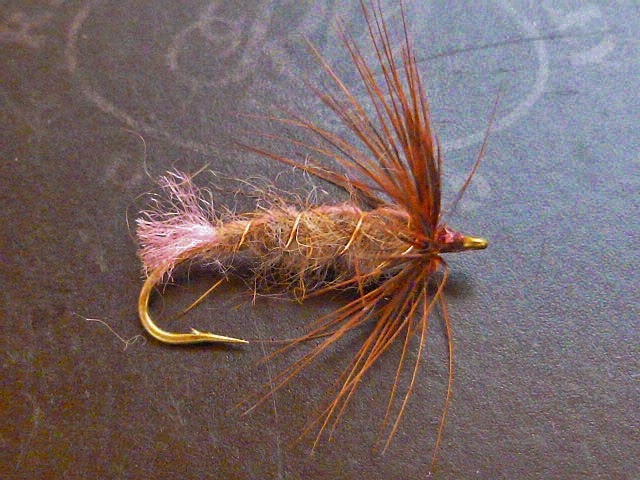
Northern Girl tied by Steven Bird
     
     It is true that pre-spawn rainbow & cutthroat develop a propensity to put brightly colored things in their mouths. Flies tied with purple, chartreuse, blue, & particularly ‘egg colors’, shades of pink, orange & red, are likely attractors in winter. Color preferences might vary according to location, yet pink seems to have universal appeal, particularly to rainbow trout. The Northern Girl is an enticing combination of attractive pink & the yummy natural nymph coloration hare’s mask provides. 

Northern Girl

Hook: #12-#14 TMC 200R

Thread: Wine

Rib: Copper wire

Body: Natural hare’s mask dubbed on loop of tying thread

Back/Tail: Section of pink yarn, tied in ahead of the body, then pulled back & held in place over the top of the hook shank while the rib is wound forward over it – trim to a short ‘tail’ (I prefer a regular pink yarn, not hot pink) 

Hackle: Furnace hen ~ & finish 

Flyfish NE Washington with Steven Bird:  http://ucflyfishing.blogspot.com
    

Thursday, December 5, 2013

PULP FLY Volume Three ~ & A Word With Bruce Smithhammer


    Flyfishing is not merely a diversion or pastime, or even an escape, but rather, a portal of sorts, leading to a harder edged & brighter reality where more than the expected unfolds & reflection hints at fractal truths, ever revealed. Our activity, our aim to fish, is only the departure point to a deeper emersion in the crucible of experience. For me, artful writing evokes a similar affect. And that is a process shared among us, & well understood by the authors contributing to the Pulp Fly story anthologies. Pulp Fly Volume Three is out, with stories by Erin Brock; Alex Landeen; Pete McDonald; Miles Nolte; Tom Reed; Tom Sadler; April Vokey; Bob White; Steve Zakur; Jay Zimmerman & Bruce Smithhammer. I was impressed with the idea & the writing contained in the first two volumes of Pulp Fly, so I contacted writer/editor Bruce Smithhammer, & he agreed to an interview with Soft~Hackle Journal, which went thus:           

SHJ: This one might make you feel a little uncomfortable, but SHJ is primarily about fly tying so I have to ask you this one: Have you ever snipped anything from a pet for use as fly tying material? the kitty’s whiskers for mayfly tails? Be honest. And don’t worry this isn’t a purity test. The arctic fox-like tip of Foofoo’s tail, maybe?    

Bruce: It doesn't make me uncomfortable at all, actually. I've snipped materials from many animals, and I really enjoy making a game out of doing it surreptitiously. It's kind of a "counting coup" thing. Maybe some day I'll share the recipe for my 'Schnauzer Clouser.'

SHJ: This one might be uncomfortable too, but salient, I think: If all the fishing water were suddenly privatized, would you advise carrying fence-cutters?
Bruce: I would advise a lot more than just carrying fence cutters. I unequivocally believe that the very heart of our democracy, and the manifestation of the American experiment, are embodied in our visionary system of public lands. And that's not hyperbole. Only tyrants would seek to deny people of honest and healthy recreational opportunities on lands that are currently held in the public trust. And as such, they should be treated they way tyrants have been throughout history, with the citizenry rising up, wielding the swift hammer of justice and the unwavering values that prompted the beginning of this country to begin with. Take that as you will.

SHJ: Do you think letters of literate discourse & repartee on the internet will ever meet the artistic depth of civil expression enjoyed in the cafes & salons of old Paris or Vienna? or have they?    
Bruce: I think that as long as there are literate people, there will be literate discourse. "Civil expression?" I'm not sure the existentialists, the expressionists, etc. were all that 'civil,' to be honest. 

SHJ: It’s always been about the words. Beginning with Dame Juliana there has always been a strong literary tradition juxtaposed with our sport, as well as journalistic. I love an evocative fiction, but also a straight-forward, informative how-to article. And I cringe when I read new writers berating ‘mainstream’ publishers for presenting style they consider less than literary, while not seeming to realize that much of what they condemn was never intended to be ‘creative’ writing, but rather, informative writing. I can think of guys who are fly-designing savants yet are less than great shakes as writers, but I’m glad they publish. And that kind of stuff is approachable to kids just starting out & they learn from it. As for fiction & memoir, the greatest portion I’m seeing in books & sporting magazines is robustly creative & not clichéd, there seeming to be a sensitive avoidance of that on the part of editors these days. Anymore, I don’t think publication is difficult because publishers are reticent to take chances with new fiction, but rather, there is an incredible number of good writers working the genre & a fairly limited number of outlets for the work – competition for available placement is extremely competitive. Do you agree?   
Bruce: Do I agree? Not entirely, but it would take a short essay to explain why. Suffice to say that I do think there is a fair bit of risk-aversion in traditional media these days, for all the usual reasons. And that this isn't coincidental to the current state of things.

SHJ: What does the publishing landscape look like to you right now (self-publishing versus traditional publishing) & where do you think it’s going for new writers who are stretching the genre?
Bruce: Contrary to what a lot of people seem to be saying right now, I actually think it's a pretty exciting time in the publishing business. Things are changing rapidly, some old models are dying, some new ones are taking shape. Volatility breeds opportunity. Suffice to say that I think there are more opportunities than there have been in a long time for people to distribute their work to a potential audience, and a number of the old hurdles are falling by the wayside. "Circulation" for example, is now instantaneous and international, and doesn't have to be limited by how many units you can afford to print and mail, for example. But it still takes elbow grease, and knowledge of how it all works, to publish effectively. I've always believed that if what you want doesn't exist, then it's time to get off your ass and create it. This is why we (Michael Gracie, myself and our esteemed contributors) started Pulp Fly - to take advantage of new technologies to help writers get their work promoted and distributed. We bring a serious editorial eye, attention to detail throughout every level of the publishing process, and the promotion and wide-ranging distribution that we believe our writers deserve. And we're able to take risks that traditional publishing largely doesn't seem to be willing or able to take anymore. 

SHJ: Last one. Everybody’s dying to know: Do you think we’ll make it off the planet on time?
Bruce: Some of us already have. And that's already more than I should share...

Thanks for that, Bruce. You’re good off the cuff. Intuit informs me you can
be trusted to drive.

Remember, everybody, Xmas is coming, & if your knowledge of gear is not at least equal to the angler’s on your gift list, then you’d better play it safe, do the smart thing, & buy them a copy of Pulp Fly.  http://pulpfly.com/volume-three/


Saturday, November 30, 2013

Woodcutter ~ A Palmered Wetfly

Woodcutter tied by Steven Bird

     For a long time a simple dark-olive & brown Wooly Worm, no tail, was one of my staples, especially when fishing freestone streams, where it serves to simulate many of the larger nymphs: drakes, stoneflies, dragonflies, & also sculpin & crayfish. Good as the olive & brown Wooly is, I can never resist tampering with things &, one day, I was looking at some plates of  palmered Irish wetflies & thought the style might lend itself well to my old favorite. A few misconceived trials &, it eventually did – the result being somewhat more elegant laying in the box, as well as a reliable hard worker in the water. Though I designed the Woodcutter with local freestones in mind, the Irish fish this style in stillwater (‘loughe flies’) as well, & I can attest it does work to simulate dragonfly nymphs in lakes, trolled or stripped; & in a #10, it fishes for the big Traveling Sedge of Northwest lakes; so the Woodcutter is versatile.  

Woodcutter

Hook: #8 TMC 200R

Thread: Yellow

Tag: Copper tinsel

Rib: Copper wire

Body: Wapsi Superfine BWO blend dubbed on a loop of the tying thread – build up the underbody to a nice cigar shape with yellow sewing thread (or lead wraps) – when I want bulk, I save time & expensive tying thread by mousing with sewing thread – works for dubbing on larger patterns, as well

Palmer: Brown shlappen – 5 turns evenly over the body (Saddle hackle can be used)

Hackle: Two turns of speckled brown hen (I used Welsumer hen on the sample in the foto, but I also like brahma or pardo coq-de-leon hen for this one) - & finish.        

Welsumer Hen
Flyfish NE Washington with Steven Bird: http://ucflyfishing.blogspot.com

Thursday, November 28, 2013

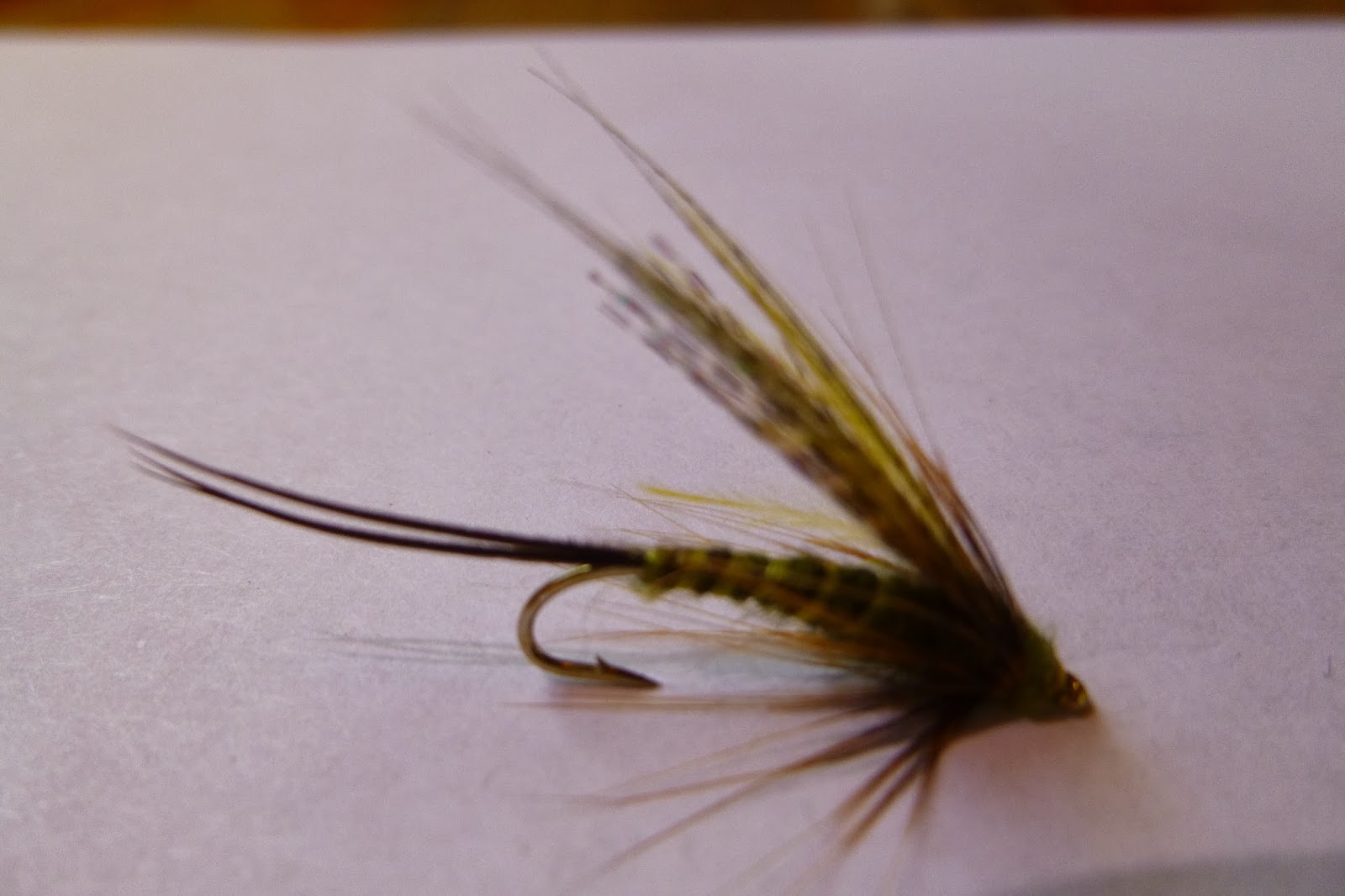
Sunset Baetis

Sunset Baetis tied by Steven Bird

I like this one for meeting red quills in low light conditions & June evenings, right up against dark when the bugs are thick & I want something that will stand out a bit from the crowd. Covers a variety of baetis & also western march brown. I fish it quartered, swung, dangled & lifted, downstream, but also fished upstream & dead-drifted, as the situation seems to call for.

Sunset Baetis

Hook: #12-#14 Daiichi 1150

Thread: Brown

Abdomen: Yellow floss overwound with copper tinsel – space winds so that the yellow shows as a rib – I spread a drop of Loon Hard Head on the body which serves to preserve the mylar tinsel & lend depth

Thorax: Dark peacock herl


Hackle: One turn of plover wing covert – & finish

Flyfish NE Washington with Steven Bird: http://ucflyfishing.blogspot.com

Tuesday, November 19, 2013

Larger Western Mayflies of Autumn

Lesser Green Drake tied by Steven Bird
Mahogany Dun tied by Steven Bird

      Wetfly takes on a couple of larger mayflies that are a significant autumn presence in the West: The lesser green drake (Drunella flavilinea); & the mahogany dun or blue quill (Paraleptophlebia bicornuta). Both of these mayflies occur over the spectrum of stream types; both are generally about the same size, #12-#14; & neither produces substantial hatches (that I’ve encountered), yet imitations of either are worthwhile, as they are in the mix, flavs into October, & mahogany duns into November or even later in southern ranges.

I think of the lesser green drake & mahogany dun as a ‘seasonal hatch’, their imitations worthwhile for ‘fishing the water’ throughout the season, in areas they are present. As nymphs, both of these species are crawlers; & both migrate to shallow water prior to final emergence. I think trout just as often see emerging, stillborn, or drowned spinner versions of  ‘flavs’ & mahogany duns, so, for that reason, I fish ‘winged’ patterns, which serve to cover those three modes: emerger/stillborn/spent adult. 
Profile of Lesser Green Drake Wing

Looking at the winged wetfly patterns here, & if you go back & look at Allen McGee’s mayfly patterns in the prior Journal entry, you'll notice that though the mayfly designs pictured are winged, they aren’t really “winged wetflies” in the traditional sense. The paired quill wings of ‘traditional’ designs are objectified & heavy, with little movement, tending toward somewhat less than diaphanous. The wings of mayflies, even drakes, are delicate, often transparent or semi-transparent so, to my mind, ‘less-is-more’ seems a good approach to simulating wings. Trout can see very well, & if they see too much, there is too much that can be seen as questionable & be rejected. But just a hint. An insinuation of a wing. Just a few fibers of light reflecting antron simulating a wing on a small fly, leaves little to dismiss as suspicious. The wings of mahogany duns remain colored through all stages, becoming semi-transparent toward the rear portions in the spinner stage. Both flavs & mahogany duns display & retain the most color &, in the case of flavs, veining, on the forward portions of the wings, & it is just the forward portion I'm attempting to simulate. 

Lesser Green Drake

Hook: #14 TMC 200R

Thread: Yellow

Tail: Black - three heavy feather fibers

Rib: Yellow latex 'floss' wound over the abdomen

Abdomen: Dark olive (BWO) Wapsi Superfine dubbed on yellow sewing thread – bodies on these are robust, build up with sewing thread

Thorax: Dark olive Wapsi Superfine

Wing: Stack: about a dozen natural mallard or gadwall flank fibers; a couple barbs of yellow marabou; 3 or 4 strands of olive or blue dun midge flash; top with a few fibers of olive-dyed mallard flank

Hackle: One turn of brown speckled game hen

Head: A turn of dark olive dubbing – & finish.


Mahogany Dun

Hook: #14 TMC 200R

Thread: Rusty brown

Tail: Ginger hackle fibers

Abdomen: Mahogany-brown goose biot

Thorax: March-brown Wapsi Superfine dubbing

Wing: Medium blue dun sections taken from a very soft secondary feather (I gather those dropped by molting gulls) – train opposing quarter inch sections straight out from the feather stem, fold together & cut from the stem for a matched pair

Hackle: One turn of ginger hen hackle – & finish.  


 Flyfish NE Washington with Steven Bird: http://ucflyfishing.blogspot.com


Sunday, November 10, 2013

Bird’s Riff On Carey Special

Bird's Carey tied by Steven Bird

     The old Carey Special is native to interior B.C. & stands as an indigenous pattern that has survived generations of popularity, while remaining mostly unknown beyond its native precincts.  And not unknown for lack of virtue as a getter, the pattern is a staple for lake fishing in my neck of the woods, but for the ambiguous nature of the fly itself, not being any one fly, but a pattern, a tying style, apparently too loosely defined to carry the name any great distance. You’ll find versions of it in fly boxes all over British Columbia, where it is extremely popular, & that popularity shading into Alberta, Washington, Idaho & Montana. Variants of the Carey are staples for lake fishing in Northeastern Washington & the dragonfly-rich lakes of the Okanagan region, both sides of the U.S./Canada border.   

The Carey Special was developed in the 1920’s by Colonel Tom Carey, a retired British soldier who, legend has it, came to the Okanagan wilderness of interior B.C. – Kamloops redband country – where he set up his tent at Arthur Lake, on a mission to develop the perfect trout fly. The perfect trout fly, the original version tied with a body of marmot fur & hackled with two to four cock ringneck pheasant rump feathers, was meant to simulate a dragonfly nymph. Carey called this version the Monkeyfaced Louise or The Dredge. As time passed more versions arose, with bodies of black bear or other fur dubbing, also deer hair, peacock herl, pheasant tail, colored yarns, fluorescent yarns, tinsel, chenille, all-black versions, steelhead versions – the pattern continually morphing, the only constant: the collar of pheasant rump hackle. The inspiration for the pheasant rump hackle may have come from an earlier B.C. pattern called the Pazooka (from local Indian slang, meaning ‘the medicine’). And I suspect the Carey design harkens back to the ancient designs of Britain.

There’s been many a battle won, I can personally attest, & regional popularity of the design does bear witness, yet, so far, Colonel Carey’s original mission remains unfinished, a victory never declared, the fly, never becoming one thing, only the ambiguous grail of a bright season at Arthur Lake. Yet the quest is not lost, as, somehow, the development of his design went fractal. So the nexus of Carey’s impossible mission has proven energetic if not attainable. Ah well. It’s the journey. It’s the journey. It’s the journey. The pattern continues to morph while still retaining its name – the name that Colonel Carey did not give it.

Everybody in the interior Pacific Northwest ties their own variant of the Carey Special. They are tied mostly tail-less, but also with a short, sparse tail of pheasant rump. And I’ve found that the Carey style does travel very well, a capable bait, particularly in still water & wherever fish are feeding on dragonfly or damselfly nymphs. A few of my favorite old-time Carey variants are tied with bodies of dark olive chenille; gold tinsel; peacock herl with a tail of golden pheasant tippet. The version featured here is my own take on it, trying to stay true to Colonel Carey’s original mission. This one fishes the local lakes, simulating dragon & damselfly nymphs, & also the big ‘traveling sedge’ habiting the lakes of my region.

Bird’s Carey

Hook: #4-#10 TMC 200R (Spending two or more years as nymphs, there are always the larger models available. I usually carry this in #6, & #10 to cover traveling sedge.)

Thread: Olive

Rib: Olive wire wound over the body – heavy, or medium for #6 & under

Body: Variegated brown wool yarn (mix of chestnut & darker brown)

Hackle: Cock ringneck pheasant rump feathers – take two of the soft, long barbed, church-window feathers from the base of the rump patch, one with brown tips & one with the greenish/bluish tips – one turn of each. Hackle should extend slightly beyond the hook bend. Work the hackle back & against the body with your fingers (or hold the fly under running water for a minute) – & finish.


     Flyfish NE Washington with Steven Bird: ucflyfishing.blogspot.com

Tuesday, November 5, 2013

Flyfishing & Writing ~ Scott Sadil


Evocative literature is a natural match for evocative fly patterns. Many of this journal's readers enjoy both, so I thought it might be a good idea to celebrate the first anniversary of SHJ with a nod toward some creative friends who produce both -- some of the folks Soft~Hackle Journal has been drawing inspiration from lately.

The first guy I tapped is Scott Sadil. Scott is a teacher, adventurer, wordsmith & soft-hackle brother who, it became apparent shortly into our initial conversation, harbors the observational skill of a heron. A skill we appreciate. The dude is a rare combination: a fine creative writer and a thoughtful fly designer & natural angler. Scott’s fly patterns hint at the intuitive/associative process we see embodied in the designs of those who spend a lot of time on the water pursuing the fishes & thinking about stuff, & his writing reflects that process at work.


I asked Scott for an excerpt salient to our game, and he gives us this from Fly Tales: Lessons in Fly Fishing Like the Real Guys

“So much has been made of late for the efficacy of the wet fly swing by soft hackle aficianados like Sylvester Nemes and Dave Hughes that I’m surprised how infrequently I see other anglers employing this timeless and elegant technique.  This is, I confess, my favorite way to explore broken, seamy, or riffled water.  The mix of currents means your fly swims at different speeds, sometimes swinging, sometimes adrift on a slack line.  Practiced wet fly advocates fiddle with the angle of their casts, the timing of mends, the choice of dressing and hooks, all of which affect the depth and speed of the swing, the manner in which the fly is presented through the likeliest holding water. This is subtle to a point practically beyond words.  The wet fly swing invites the shrewd manipulations of rod, line, and fly that mark the presentationist’s game.  He feels his way through a run, recognizing through rod and line—and a kind of muscle memory—those unmistakable lies that can hold trout, a tactile familiarity that grows more pronounced each time a trout grabs the swinging fly.”  

Intrigued at the flies in the photos, I asked Scott about the pattern. 

Waking Muddlers tied by Scott Sadil


“It is a true waking pattern, not meant to ride on or even in the surface membrane, but to ride or ‘bounce’ up against it from below. This, to my mind, is one of the often overlooked aspects of the soft-hackled fly: like so many things fish feed on, it rises to the underside of the surface membrane and gets trapped there by the strength of the surface tension. Fish, I believe, are much more willing to take things held below the membrane than they are to stick their noses into air, a move that essentially asks them to penetrate a new universe. The Waking Muddlers are sometimes grabbed without evidence of the fish eating, so subtle is the inhalation by the slowly risen fish. Just as often, of course, the take is visible, or, if the fly is inspected without a take, you will see evidence of the fish, which dials up angler attention in a way nothing else in steelheading can.”    ~Scott Sadil

More from Scott Sadil at his regular column in California Fly Fisher magazine, & here: http://scottsadil.com/titles.htm