Tuesday, March 4, 2014

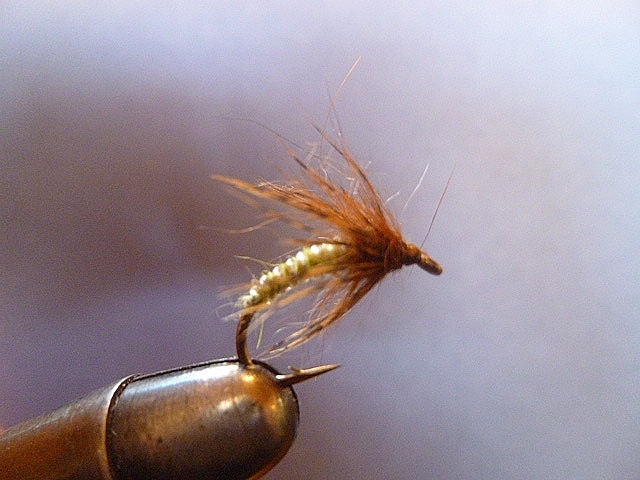
Bunny Grannom Pupa ~ Soft-Hackle Variations


     On many streams grannom caddis (Brachycentrus) are the first reliable hatch of the season. On some, this insect might be the most productive hatch of the year. In NE Washington state, grannom usually start to appear toward the end of April & emerge well into June & sometimes July, the strongest emergence usually around the end of May. Of the several species of caddis that are important hatches in my neighborhood, grannom spurs the best dryfly action, & that possibly due to their habit of migrating to & emerging from shallow water, where the pupae emerge swiftly, often times forcing trout to fill the void with the more prolific adult egg-layers, which are coincident. Nonetheless, trout prefer the wingless pupae & will eat them readily when an opportunity arises. In in my own experience, the emerging pupa is the most productive stage of grannom to imitate & fish. 

Nymphs will generally be #12-#14; & the pattern given here, tied in #10-#18 will cover a lot of caddis species besides grannom, East & West. I use this same pattern to cover spotted sedge, a more prolific & longer-lasting caddis than grannom, on my homewater. Tied in a #10 this one will cover great gray spotted sedge, & also the lake-dwelling traveling sedge. I think this version represents a fundamental soft-hackle sedge design that will turn the trick as well as any I’ve tried.

Because trout always show a preference, it is good to carry more than one version of grannom. I use the same basic tie, which gives me the profile I think simulates the pupa well, & then apply several different abdomen materials to that basic tie.    

Bunny Grannom Pupa

Hook: #12-#14 Daiichi 1150 caddis style

Thread: Camel or brown

Rib: Round silver tinsel – I use size D metallic rod wrapping thread, five turns over the abdomen

Abdomen: Olive rabbit dubbing  (you can add a pinch of chartreuse to brighten it); olive, standard tubing over silver tinsel; green rubber band; clear lace over olive floss or yarn 

Thorax: Light-brown hare’s mask – 2 turns ahead of the abdomen

Hackle: Brahma hen (you can substitute brown partridge or grouse)

Head: Light-brown hare's mask with guard hairs in - about four turns in a dubbing loop of the tying thread, actually a continuation of the thorax - & finish.
Rubber Band Grannom
Clear lace over olive yarn
Tubing over silver floss abdomen


Flyfish NE Washington with Steven Bird: http://ucflyfishing.blogspot.com

Tuesday, February 18, 2014

Little Sculpin

Little Sculpin tied by Steven Bird

Sculpin (Cottidae) inhabit virtually every trout stream in North America. There are numerous species, though all are similar & easily identified by the proportionately large head & pectoral fins. Sculpin come in shades of olive or brown with darker mottling or bars on the body & speckled on the fins & head. Some species may grow to about six inches long, though most will be shorter than four inches, & there are many species measuring only two inches at maturity. The smaller models seem to be the most plentiful in the streams I fish, & the Little Sculpin pattern featured here is meant to cover those.  It is an easy choice when I want to swing a streamer on unfamiliar water, as it simulates a major food form that larger trout are used to preying on &, for that reason, I’ve found it a good choice on hard-fished water.


Little Sculpin

Colorations vary, the pattern given here is a generic version, but colors can be adjusted to suit specific waters.

Hook: #8-#10 TMC 200R or TMC 2312

Thread: Olive, brown or black

Tailing: In order tied in: small pinch of light tan marabou; small pinch of brown marabou; one olive & one brown partridge hackle, wound as a collar, then pulled back over the tailing & tied down

Rib: Copper wire

Body: Dyed brown or dark olive hare’s mask with guard hairs, wound in a dubbing loop

Hackle: Partridge, one olive & one brown – wind on the entire feather for as much collar as possible

Head: Body dubbing, full, on dubbing loop – & finish

 Flyfish NE Washington with Steven Bird: http://ucflyfishing.blogspot.com       

Friday, January 24, 2014

Turkey Biot BWO

     I was both humbled & amused by Scott Sadil’s article in the Jan-Feb issue of California Fly Fisher magazine, featuring the Bird’s Bunny BWO, a soft-hackle pattern I tie for meeting Blue Winged Olives. Scott ties a perfect example of the Bunny. And, more important to the subject than fairly nailing my profile (glad he left it where he did), he makes a point of mentioning that there is no be-all-end-all pattern for meeting the spectrum of BWO hatches. No one sure thing. And it is helpful to anglers fishing over BWO's that Scott said that, as it is certainly true in my own experience. No matter where you fish, there are likely to occur at least a couple species of small mayflies referred to as Blue Winged Olive, & in a fairly broad range of sizes, from #14 to #24, & a variety of colorations. So, for that reason, it’s good to carry at least several versions & sizes representing BWO. The Bird’s Bunny, in a #16 or #18, is fairly reliable on my homewater & other places, yet not everywhere, nor in every situation that I’ve fished it. And, even on the same water, fishing over the same BWO species, I have noted a daily preference in what trout want – one day it’s the light colored pattern, & the next day it’s the dark one – even in the same (usually low) light conditions. Why? I don’t know, really. And also intriguing is that the trout will all be of one mind on the subject of preference, what they are going to like on a day. That is the way of trout, & whatever their reason, it’s a good idea to carry a variety of patterns to meet whatever is trending, or at least a dark & a light version in #18.  Here’s a version tied with turkey biot that is showing some promise. I like quill bodies, & really like the ease & result achieved with turkey biot:

Biot BWO

Hook: #14-#18 Daiichi 1150 (I like this hook for its up-eye, & because the wide gape puts more iron to big fish, while the short shank results in a smaller sized imitation than standard wetfly hooks. I tie a #20 on a #18. And remember: nymphs will be one size larger than the adults you are seeing, if it’s the nymph & not the drowned adult you are simulating.)

Thread: Gray or olive

Tail: Light honey-dun hen hackle fibers – four fibers, about the same length as the body

Abdomen: Olive turkey biot wound as a quill body – wind a thread underbody & apply a coat of thick head cement to the thread before winding the biot – I like Loon Hard Head for this

Thorax: A short thorax of light-medium gray rabbit or muskrat dubbing

Hackle: Light honey-dun hen – & finish~

Flyfish the upper Columbia - NE Washington with Steven Bird: http://ucflyfishing.blogspot.com  


Thursday, January 9, 2014

Resolutions & Brown Hare’s Mask & Plover

Brown Hare's Mask & Plover tied by Steven Bird 

     Since the advent of this new year I’ve been considering some resolutions for 2014. Not many, the list is short. Actually, quite a bit shorter than it was at the beginning of the month directly following the hangover resulting from the New Year’s Eve celebration at Happy Jack’s Tavern. Nonetheless, I’m feeling squared away at this point, & those things remaining on the list of resolutions might represent the nuggets left in the pan after the overburden is washed away. Here they are:

1)    Fish the Brown Hare’s Mask & Plover more often. (Sure, the hackles are rare & difficult to obtain, I have a wing & a portion of hide given to me by Bert Brehm & those hackles are begging to be fished. Well, most of them. Maybe half of them.) 
2)    Write better.
3)    Learn people better.
4)    Wear clean clothes & look decent.
5)    Let go.
6)    Dance better.
7)    Take better care of teeth.
8)    Take better photos.
9)    Stay glad.

Of course I’m reserving the right to change my mind on any of it. Flexibility is a virtue, after all.

Brown Hare’s Mask & Plover

Hook: #12-#16 (flies in the photo are tied on #16 Daiichi 1150)

Thread: Yellow

Rib: Gold wire

Body: Dyed brown hare’s mask

Hackle: Golden Plover (English grouse or sharptail grouse are fair substitutes) 

 Flyfish NE Washington with Steven Bird: http://ucflyfishing.blogspot.com

Friday, December 27, 2013

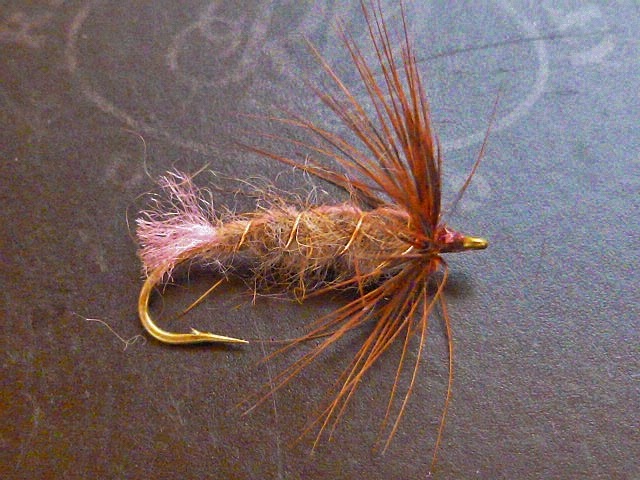
Northern Girl ~ A Winter Nymph

Northern Girl tied by Steven Bird
     
     It is true that pre-spawn rainbow & cutthroat develop a propensity to put brightly colored things in their mouths. Flies tied with purple, chartreuse, blue, & particularly ‘egg colors’, shades of pink, orange & red, are likely attractors in winter. Color preferences might vary according to location, yet pink seems to have universal appeal, particularly to rainbow trout. The Northern Girl is an enticing combination of attractive pink & the yummy natural nymph coloration hare’s mask provides. 

Northern Girl

Hook: #12-#14 TMC 200R

Thread: Wine

Rib: Copper wire

Body: Natural hare’s mask dubbed on loop of tying thread

Back/Tail: Section of pink yarn, tied in ahead of the body, then pulled back & held in place over the top of the hook shank while the rib is wound forward over it – trim to a short ‘tail’ (I prefer a regular pink yarn, not hot pink) 

Hackle: Furnace hen ~ & finish 

Flyfish NE Washington with Steven Bird:  http://ucflyfishing.blogspot.com
    

Thursday, December 5, 2013

PULP FLY Volume Three ~ & A Word With Bruce Smithhammer


    Flyfishing is not merely a diversion or pastime, or even an escape, but rather, a portal of sorts, leading to a harder edged & brighter reality where more than the expected unfolds & reflection hints at fractal truths, ever revealed. Our activity, our aim to fish, is only the departure point to a deeper emersion in the crucible of experience. For me, artful writing evokes a similar affect. And that is a process shared among us, & well understood by the authors contributing to the Pulp Fly story anthologies. Pulp Fly Volume Three is out, with stories by Erin Brock; Alex Landeen; Pete McDonald; Miles Nolte; Tom Reed; Tom Sadler; April Vokey; Bob White; Steve Zakur; Jay Zimmerman & Bruce Smithhammer. I was impressed with the idea & the writing contained in the first two volumes of Pulp Fly, so I contacted writer/editor Bruce Smithhammer, & he agreed to an interview with Soft~Hackle Journal, which went thus:           

SHJ: This one might make you feel a little uncomfortable, but SHJ is primarily about fly tying so I have to ask you this one: Have you ever snipped anything from a pet for use as fly tying material? the kitty’s whiskers for mayfly tails? Be honest. And don’t worry this isn’t a purity test. The arctic fox-like tip of Foofoo’s tail, maybe?    

Bruce: It doesn't make me uncomfortable at all, actually. I've snipped materials from many animals, and I really enjoy making a game out of doing it surreptitiously. It's kind of a "counting coup" thing. Maybe some day I'll share the recipe for my 'Schnauzer Clouser.'

SHJ: This one might be uncomfortable too, but salient, I think: If all the fishing water were suddenly privatized, would you advise carrying fence-cutters?
Bruce: I would advise a lot more than just carrying fence cutters. I unequivocally believe that the very heart of our democracy, and the manifestation of the American experiment, are embodied in our visionary system of public lands. And that's not hyperbole. Only tyrants would seek to deny people of honest and healthy recreational opportunities on lands that are currently held in the public trust. And as such, they should be treated they way tyrants have been throughout history, with the citizenry rising up, wielding the swift hammer of justice and the unwavering values that prompted the beginning of this country to begin with. Take that as you will.

SHJ: Do you think letters of literate discourse & repartee on the internet will ever meet the artistic depth of civil expression enjoyed in the cafes & salons of old Paris or Vienna? or have they?    
Bruce: I think that as long as there are literate people, there will be literate discourse. "Civil expression?" I'm not sure the existentialists, the expressionists, etc. were all that 'civil,' to be honest. 

SHJ: It’s always been about the words. Beginning with Dame Juliana there has always been a strong literary tradition juxtaposed with our sport, as well as journalistic. I love an evocative fiction, but also a straight-forward, informative how-to article. And I cringe when I read new writers berating ‘mainstream’ publishers for presenting style they consider less than literary, while not seeming to realize that much of what they condemn was never intended to be ‘creative’ writing, but rather, informative writing. I can think of guys who are fly-designing savants yet are less than great shakes as writers, but I’m glad they publish. And that kind of stuff is approachable to kids just starting out & they learn from it. As for fiction & memoir, the greatest portion I’m seeing in books & sporting magazines is robustly creative & not clichéd, there seeming to be a sensitive avoidance of that on the part of editors these days. Anymore, I don’t think publication is difficult because publishers are reticent to take chances with new fiction, but rather, there is an incredible number of good writers working the genre & a fairly limited number of outlets for the work – competition for available placement is extremely competitive. Do you agree?   
Bruce: Do I agree? Not entirely, but it would take a short essay to explain why. Suffice to say that I do think there is a fair bit of risk-aversion in traditional media these days, for all the usual reasons. And that this isn't coincidental to the current state of things.

SHJ: What does the publishing landscape look like to you right now (self-publishing versus traditional publishing) & where do you think it’s going for new writers who are stretching the genre?
Bruce: Contrary to what a lot of people seem to be saying right now, I actually think it's a pretty exciting time in the publishing business. Things are changing rapidly, some old models are dying, some new ones are taking shape. Volatility breeds opportunity. Suffice to say that I think there are more opportunities than there have been in a long time for people to distribute their work to a potential audience, and a number of the old hurdles are falling by the wayside. "Circulation" for example, is now instantaneous and international, and doesn't have to be limited by how many units you can afford to print and mail, for example. But it still takes elbow grease, and knowledge of how it all works, to publish effectively. I've always believed that if what you want doesn't exist, then it's time to get off your ass and create it. This is why we (Michael Gracie, myself and our esteemed contributors) started Pulp Fly - to take advantage of new technologies to help writers get their work promoted and distributed. We bring a serious editorial eye, attention to detail throughout every level of the publishing process, and the promotion and wide-ranging distribution that we believe our writers deserve. And we're able to take risks that traditional publishing largely doesn't seem to be willing or able to take anymore. 

SHJ: Last one. Everybody’s dying to know: Do you think we’ll make it off the planet on time?
Bruce: Some of us already have. And that's already more than I should share...

Thanks for that, Bruce. You’re good off the cuff. Intuit informs me you can
be trusted to drive.

Remember, everybody, Xmas is coming, & if your knowledge of gear is not at least equal to the angler’s on your gift list, then you’d better play it safe, do the smart thing, & buy them a copy of Pulp Fly.  http://pulpfly.com/volume-three/


Saturday, November 30, 2013

Woodcutter ~ A Palmered Wetfly

Woodcutter tied by Steven Bird

     For a long time a simple dark-olive & brown Wooly Worm, no tail, was one of my staples, especially when fishing freestone streams, where it serves to simulate many of the larger nymphs: drakes, stoneflies, dragonflies, & also sculpin & crayfish. Good as the olive & brown Wooly is, I can never resist tampering with things &, one day, I was looking at some plates of  palmered Irish wetflies & thought the style might lend itself well to my old favorite. A few misconceived trials &, it eventually did – the result being somewhat more elegant laying in the box, as well as a reliable hard worker in the water. Though I designed the Woodcutter with local freestones in mind, the Irish fish this style in stillwater (‘loughe flies’) as well, & I can attest it does work to simulate dragonfly nymphs in lakes, trolled or stripped; & in a #10, it fishes for the big Traveling Sedge of Northwest lakes; so the Woodcutter is versatile.  

Woodcutter

Hook: #8 TMC 200R

Thread: Yellow

Tag: Copper tinsel

Rib: Copper wire

Body: Wapsi Superfine BWO blend dubbed on a loop of the tying thread – build up the underbody to a nice cigar shape with yellow sewing thread (or lead wraps) – when I want bulk, I save time & expensive tying thread by mousing with sewing thread – works for dubbing on larger patterns, as well

Palmer: Brown shlappen – 5 turns evenly over the body (Saddle hackle can be used)

Hackle: Two turns of speckled brown hen (I used Welsumer hen on the sample in the foto, but I also like brahma or pardo coq-de-leon hen for this one) - & finish.        

Welsumer Hen
Flyfish NE Washington with Steven Bird: http://ucflyfishing.blogspot.com